Dark spots or patches on the skin are a very common skin issue. These include post-acne skin marks, which can stay on your skin for months after the pimples are gone; melasma, which are larger patches of pigmentation (often caused by hormone changes during pregnancy), and age spots. The stages that your body goes through in producing hyperpigmented areas are the same, regardless of the cause or size. If you understand the process behind their formation, you’ll be better positioned to combat them. Your body goes through several stages before the pigmentation actually appears on the skin, and it’s best to treat as many of these stages as possible at the same time.
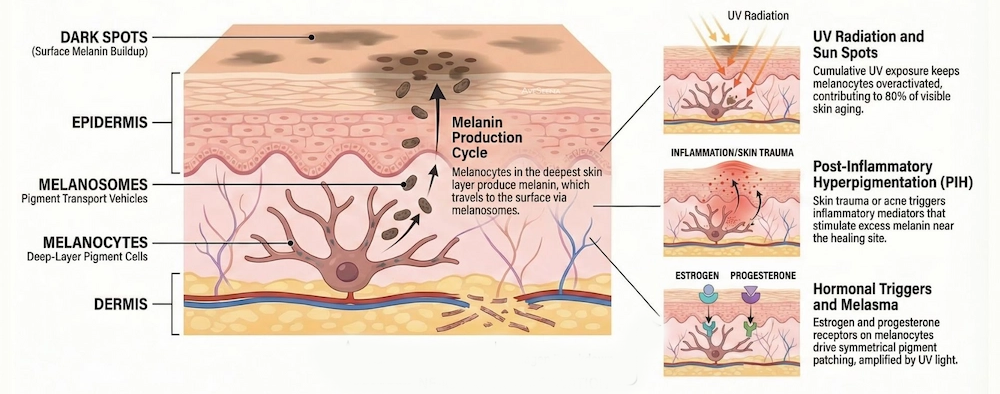
If you look at the diagram, you will notice these big, grungy cells called melanocytes. These are at the very bottom of the topmost layer of your skin (the epidermis). These guys are step 1 in the pigmentation process and are supposed to produce just the right amount of pigment (called melanin) to keep your skin looking nice, with an even tone. The melanocytes create melanin inside of little factory packets called melanosomes, which they then transport up through those structures at the top that are called dendrites, but always look like some kind of weird sea algae to me. The melanosomes are transferred to the main cells of your upper skin layer (keratinocytes), which then travel to the outermost surface of your skin, where they display your pigmentation for all your friends to appreciate and admire. They will eventually slough off and be replaced by new keratinocytes. The entire cycle takes about two months, around four weeks for the keratinocytes to get to the surface, and another four weeks or so for them to disappear. This is extremely variable and depends on age, activity, and many other factors.
Normally, this all works perfectly, and you look gorgeous. But the melanocytes can be triggered into overproducing melanosomes, and that's where the problems start. It's like the classic Lucy on the assembly line skit - she can't keep up and even tries eating chocolates, but she can’t even eat fast enough:
TREATING STAGE 1:
ELIMINATE TRIGGERS
Eliminating the overproduction is the best place to start. How you treat it depends on what is causing it. If it's skin damage (perhaps caused by acne), you'll want to treat your acne. If it's a pregnancy, you're just going to have to wait (that's about 9 months, but you probably knew that already). If it's skin irritation, then avoid irritating your skin and employ anti-inflammatories and anti-oxidants. If it's genetics, there's nothing to be done about that, at least not yet.
GOOD NEWS/BAD NEWS
By far the most common trigger is sunlight, so your first and most important defense is sunscreen. Use a broad-spectrum sunscreen that protects against both UVA and UVB rays. Without it, all other hyperpigmentation treatments will be far less effective. Preventing sunlight exposure with sunscreen is the key step, but it can be a challenge to find one that works for your skin and is comfortable to apply regularly. Sometimes, sunscreens can irritate your eyes or feel unpleasant, but consistent use is critical. Fighting hyperpigmentation without sunscreen is as futile as trying to empty a quickly filling bathtub with a thimble. Protecting your skin with high-quality sunscreen is essential for managing dark spots.
Most sunscreens are good at blocking UVB and UVA2 (that's what the SPF number measures), but to fight pigmentation, you want one that will also block UVA1. These are longer wavelength rays that penetrate deeper into the skin. They are the primary cause of photaging (both wrinkles and pigmentation). Finding a sunscreen like that in the U.S. is pretty hard right now. There are new ingredients (Tunosorb S & M) which do a great job of blocking UVA1, but these aren't allowed in combination in sunscreens in the U.S. They also make sunscreens more comfortable to wear, so that's another loss. If you want more information on sunscreens and this situation in particular, I think Dr. Michelle Wong is the person to follow. Here's a short NPR segment interviewing her on this topic:
Leaving aside the ingredients, the most important thing is to apply enough sunscreen. You need at least 1/4 teaspoon for your face. Apply sunscreen every time you go outside, and reapply every two hours, even if you are in the shade or on cloudy days. Also, use hats and sunglasses. There’s a lot to learn about sunscreens. Listen to Dr. Wong—I’ve learned a ton from her.
If you have acne or skin irritation, treating those should help reduce or eliminate your hyperpigmentation.
STEP 2: REDUCE PRODUCTION
The melanocytes produce melatonin using tyrosinase. Tyrosinase is an enzyme that turns tyrosine (an amino acid) into melanin. This is where most of the pigment-targeting ingredients you hear about work. These products work by inserting colorless tyrosine-shaped molecules into the assembly line. When tyrosinase reaches for a tyrosine-shaped thingy to make brown stuff, it gets something that isn't tyrosine and won't make pigmented stuff. But tyrosinase doesn't know that, so it creates the melanosomes without melanin.
There are many ingredients manufacturers claim will work for this. But as usual, just because you see it in a product doesn't mean it will work. Remember that melanocytes are buried pretty deep, so you'll want a formulation that can actually make it to the target. In making your decisions, look for clinical data as well as user reviews to help you make your decisions.
The best known one is hydroquinone. It's so effective that it’s often referred to as the gold standard. It can actually kill melanocyte cells and break down existing melanosomes. It’s almost too effective. It’s best to use it as a spot treatment only on dark areas. If you use it across your entire skin, you will make the entire skin lighter, but not reduce the contrast between the dark and light areas, so you will still have uneven pigmentation.
Another ingredient that is known to work is N-acetylglucosamine (NAG). This works by keeping tyrosinase from converting to its active form. Yes, it's complicated. Like the last person you broke up with, tyrosinase has to be in the right mood before it will do anything. So NAG (nice name) basically keeps Tyrosinase in a bad mood, and it refuses to do any work. Incidentally, if used in combination with Niacinamide (a stage 3 treatment), they both work better. I’ll mention this again later, so you don’t forget.
Plant antioxidants for stage 2.
Several plant-based antioxidants can interfere with stage 2 melanin formation. Tyrosinase needs copper to do its thing, and these antioxidants bind tightly to copper (a process called “chelating copper”), preventing tyrosinase from getting any. Think of it like starving the assembly line worker. Of all the plant-based antioxidants, L-ascorbic acid (LAA) works best. Unfortunately, it's also the most problematic because it can increase skin irritation, and as you know, skin irritation triggers melanin production. I generally avoid it for this reason, but there are derivatives which are both more stable and gentler than LAA, if somewhat less effective. It's also an excellent antioxidant.
Azelaic acid is another effective option. Besides interfering with melanin production, it also reduces acne and skin irritation (stage 1!). It’s very safe. The problem with azelaic acid in our stage 2 scenario is that it really doesn’t start to work on melanin production until you get to a 20% concentration. That can be difficult to find, and it’s also very thick and sticky, so many people find it too unpleasant to use.
Arbutin is hydroquinone with a sugar attached. Beta arbutin is the natural version, found in pears and blueberries. Alpha arbutin is synthetic. I generally prefer synthetics to plant extracts because you never really know what you're getting with plant extracts, due to incredible variation from where and how the plant was grown and stored. This variability makes it difficult to adjust dosages.
Glabridin is an extract of licorice; there is no synthetic version as far as I know. My advice on this (which you are free not to follow) is to just treat it as a bonus if you see it in a formulation and hope it works. I wouldn’t waste much time looking for it.
I’m not trying to be a bitch here (it is effortless for me), but I have to remind you that if you aren't treating the triggers (for example, with sunscreen, oh yeh), then you’re wasting your time and money with these later-stage products.
HANDLING STAGE 2 TREATMENTS
Many of these stage 2 treatments can increase skin irritation, which will just make your hyperpigmentation worse. This is called "rebound hyperpigmentation". This doesn’t mean you should stop using them. If you experience rebound, stop for a few days, then try smaller doses or less frequent ones.
And a word of warning: hydroquinine is often marketed in illegal bleaching creams. The amounts are super high, and it is often combined with really dangerous stuff like mercury, both of which can lead to permanently patchy light areas and damage other parts of your skin.
STAGE 3 TREATMENTS
Stage 3, which involves the transfer of the melanocytes to the skin cells (keratincoytes), can also be interfered with. That's a good thing. Unfortunately, you have fewer choices for this stage. The main one is niacinamide, which has a lot of good studies to support its use and is very gentle. As I mentioned earlier, it also has a synergistic effect with NAG: both of them used together make each work better than when they are used separately. There's also some evidence for soy extract. I wouldn't go crazy looking for it, but if you see it on your bottles, that's not a bad thing.
Tranexamic acid (TXA) has gotten a lot of press. It probably works well when taken orally, but it's also available in topical preparations, and I’m not a believer. Use it if you want. It probably won't do you any harm when applied topically, but I doubt it will penetrate the skin deeply enough to interfere with transfer.
STAGE 4 TREATMENTS
Stage 4, skin turnover, is when the cells move up through the skin and shed. This is the only stage where you can see quick results. Retinoids speed up skin cell multiplication, which dilutes and eliminates pigments faster. Retinoids are also anti-inflammatory and can reduce tyrosine production. No surprise here: retinoids are good.
There are physical, chemical, and enzyme exfoliants. Chemical exfoliants like hydroxy acids are generally the ones recommended. Alpha hydroxy acids tend to make the skin more sun sensitive, so make sure you are wearing sunscreen and hats. You should do that anyway. Salicylic or polyhydroxy acids don't seem to have that effect. But even with these, you should be wearing sunscreen anyway.
You can get stronger versions of these at a doctor's office by getting a chemical peel. They might use hydroxy acids in stronger concentrations, or stronger acids like glycolic acid. The goal here is to remove a lot of skin. There are also lasers that break up melanin, and they can reach much deeper than topical treatments.
All of these clinical treatments have dangers, especially if you have darker skin. There are gentler peels and lighter lasers (pico lasers) that can lower the chances of rebound pigmentation, but if your skin is really dark, it might be best to avoid these. For sure, check that the person doing the procedure has lots of experience with skin tones similar to yours.
FINAL WORDS
The most important aid you have here is patience. Other than stage 4 treatments, it takes a long time to tell if things are working. Remember that it takes up to eight weeks just for the melanin to reach the surface of your skin, where it will be visible. In reality, it will probably take longer to see differences. Do pay attention to what your skin is telling you. More than most skin treatments, hyperpigmentation varies widely from person to person.
And don't forget your sunscreen.